Paromita Kar Toronto Dance Artist
Blog of Toronto-based dance artist Paromita Kar.
Tuesday, February 3, 2026
Dance at Guelph Gala 2026 Fashion & Art Event
Monday, September 9, 2024
Worli Paintings and Dance
I had a brief sojourn to a different part of India, to Maharastra during my stay and was taken to Aurangabad, to the region of Gol Tekadi Hills. There I encountered a different form of adivasi (indigenous) art, and the representation of dance within this art. I was fascinated by the visual representations/iconography of the Worli Paintings, and their usage in decorating outdoor spaces.
The Worli community is an indigenous community native to the northern Sahyadri hills of Maharashtra. Their paintings are most often done on the walls of the houses. This tradition is believed to date back to the 2500-3000 BCE, and traditionally only used white paints and pigments.
As seen below, this style of painting frequently depicts multiple human bodies engaged in day-to-day tasks, such as preparation of food, grinding of grains, hunting, or dancing in a group. The body shapes are depicted primarily through triangles, with a triangle each forming the upper and lower part of the body. Frequently the dancing is represented with a large ensemble of individuals, mostly women, with joined hands, and dancing in spiralling group formations. This dance form is called "Tarpa", and is a large social dance form. There is a sense of movement indicated in this spiraling.
Friday, April 9, 2021
Watching Uzbek Culture and Theatre during the Pandemic: The Five Wives of Hadja Nasreddin by Uzbekistan State Drama Theatre
Over the course of the past several months, while staying at home during the multiple lockdowns in our Ontario province in Canada, I have had the privilege and pleasure of attending a number of online Uzbek arts, culture and performance events on Zoom organized by European Bank for Reconstruction and Development in association with Orzu Arts of England and British Uzbek Society. I started attending these Zoom events around Christmas time; with my first being an Andijan Polka dance workshop taught by Gulandom Qurombaeva, and later the masterclass on the Mustahzod taught by Mashxura Tolibovna. The experience, cultural engagement and educational value offered by these workshops and masterclasses was truly enriching and well-worth getting up in the early hours for (I woke up at 5:00 am to make it in time for the 6:00 am workshops in December and January which were offered in London time).
I’ve recently also attended a number of sessions scheduled during the Spring in celebration of Nowruz. One of these offerings was a screening of the performance of The Five Wives of Hadja Nasreddin, directed by Rasuljon Tagaykulov, performed by Uzbekistan State Drama Theatre, which I had the opportunity to watch yesterday. Being a Theatre Minor from Queen’s University, and having taken a number of Theatre Department courses during my PhD in Dance Studies at York University (Department of Dance, York University), I was truly excited to watch this production, which was my first exposure to theatre performance from Uzbekistan. Sharing below a few reflections and screenshots I took on phone while watching the production!
The set design for this production features rich decor and detail, with 5 striking curtained doorways adorned with suzani and other traditional textile panels. The set in itself makes the play a visual treat!
I particularly enjoyed watching tableau moments of the characters gathered at centre in their colourful traditional costumes, making a very memorable visual experience.
The most fascinating part for me was the establishment of the characters through dance and movement elements. The play begins with all five wives entering the stage and performing a short dance in unison, singing “The mind of a women cannot be conquered by any man.” They are accompanied by prerecorded singing and musical accompaniment.
Later in the play, as each of the five wives is introduced, they perform a short dancelike segment performed to the doira (frame drum), sometimes accompanied by their own singing, sometimes just with percussive accompaniment, establishing the distinct character and persona of each wife. We are introduced to the first wife, Jannat, the daughter of the executioner; the young and flirtatious Tamanna Banu who is the second wife; the third wife, the cleaning-obsessed Zubeida; and the fourth wife, Tutikhon, who is hard of hearing. Finally, we are introduced to his original wife, Fatima. The percussive motifs were different for each wife character, and each actress danced with a distinctive physicalization. Zubeida dances around the space with a broom, and sings about her obsession of cleaning. Tutikhon introduces herself with dance, singing as she dances, and her song itself is about dance. The second wife, Tamanna Banu, also depicted as the youngest wife, dances the most frequently, introducing herself later to Nasreddin’s original wife, also by dancing.
In the post-screening discussion session with the director and cast, it was revealed that the most challenging part of the artistic process of the production was rehearsing during the pandemic, especially in regards to spatial blocking and movement, as rehearsals were done largely via Zoom. It is truly heartening to see theatre workers and cultural workers continue their valuable work during this pandemic. While travel is not an option currently, it is exciting to wake up early or stay up late at odd hours to experience and learn art. Gratitude to organizers such as EBRD, Orzu Arts and British Uzbek Society who make it a possibility during these challenging times with these initiatives!
Tuesday, May 29, 2018
Culinary Adventures in Learning Music and Dance
Our study into the music and dance, especially dance, is not complete without a study of the contextual clothing culture and jewellery of the region and specific culture that the dance practice springs from. To this experience, Mike and I also add in the adventure of exploring the cooking foods of the cultures we study music and dance from. It is part of our preparations before we go to a new culture for immersive study, as well as after our travels. Before our 2015 study trip to Turkey, where I was studying Turkish Romani and Anatolian dance forms under a Canada Council for the Arts grant, Mike and I attempted our own versions of Turkish cooking from traditional recipes. Several of the dance forms I study draw inspiration from the activities of everyday life, including activities involved in preparation of food, such as churning of butter, fetching water from the river, preparing desserts, stirring pots of honey for baclava, gathering wheat during harvest, preparing tea, delicately carrying tea glasses, cutting pomegranates, pouring tea, and many other activities. I find that the corporeal experience of cooking the foods brings me a little closer to the realities of these physical experiences.
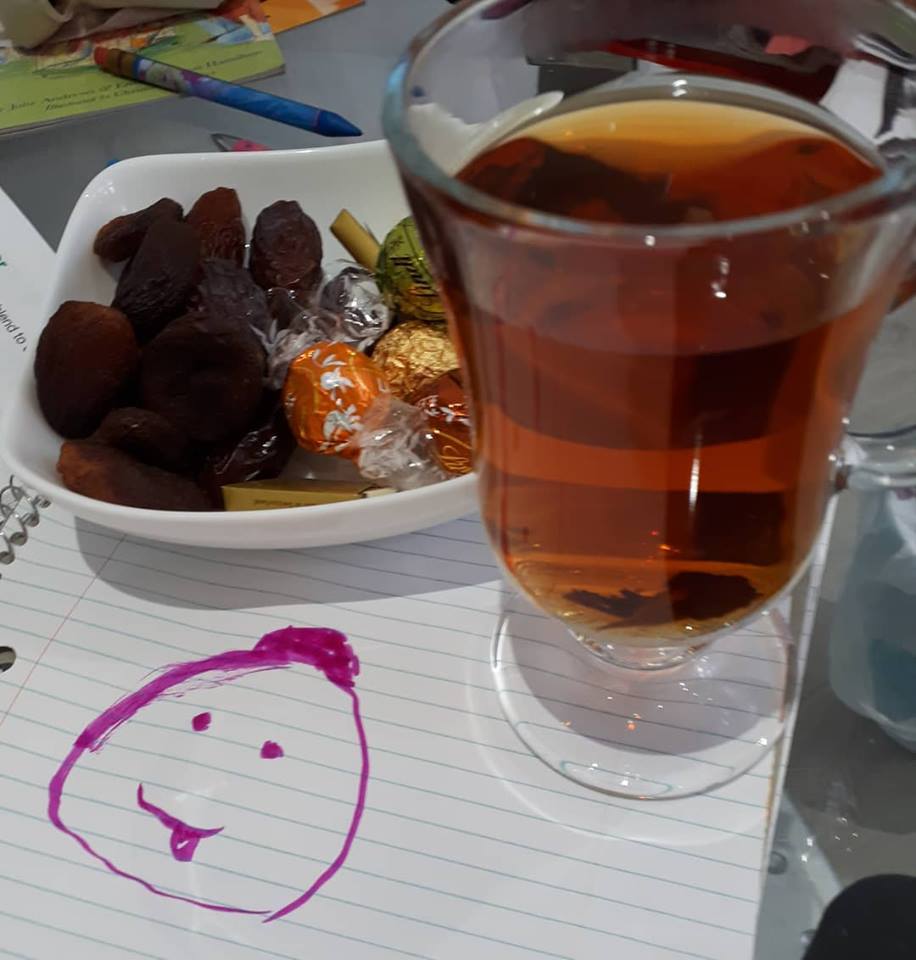
It is also interesting how the different preparations include different physicalities. I include below two different photos of tea/chai, which would involve very different physicalities in preparation:
In Toronto, biting into the delicious and crunchy sweetness, I found that the zalabiya's overwhelming sensory hit suddenly made me think of the interconnectedness of so much food throughout the Silk Road, which is an area of focus in our artistic work and scholarly study at Ensemble Topaz. I thought I would start my first post of this year, which has already been a very busy year, with the taste of something sweet. In the coming weeks, I hope to write about my recent dance learning adventures in Rajasthan, India, where I studied the Kalbeliya dance and its allied movement and music traditions, with gratitude to the Ontario Arts Council and Chalmers Family Foundation. In the meantime, I might also try to make zalabiya from a traditional recipe.
Current Read:
- "Sweet Delights from a Thousand and One Nights: The Story of Traditional Arab Sweets" by Habeeb Salloum and Leila Sallomiartas
Wednesday, August 9, 2017
A Few Updates from a Busy Month
The Canada Day weekend at the start of July was an exciting and fun start to the month. I performed earlier in the day at Pickering Markets Canada Day Diversity Celebration in Pickering, and that evening, the dancers of Ensemble Topaz and I performed at a beautiful wedding at The Vue in Etobicoke.
The next day, the dancers and musicians of Ensemble Topaz performed at the Ontario Place Mainstage, for the Ontario Heritage Festival. This was a fun gig..the musicians performed a combination of traditional tunes as well as some of Mike Anklewicz's original Klezfactor compositions, while the dancers and I performed three different styles of dance. This was my first time visiting Ontario Place, which has been newly renovated, and I found the grounds beautiful. It was also fun and refreshing to work again with live music, although we missed our bandleader Mike, who was playing his own gig at the Redpath Waterfront Festival just a few kilometres away!
Photo Credit: Larry Anklewicz
Sunday, April 30, 2017
Dancing in Intimate Spaces and Salons
Last year, I had another interesting salon-space performance experience, at the Bellerive Room inside Toronto's beautiful Aga Khan Museum, during my Pop Up Performance weekend in November. Here's a photo from this performance in this beautiful Persian salon-style room, which also houses the Aga Khan family's private collection of ceramics. My last two performances on each of the two days were held in this room.
Photo Credit: Amin Bhanji
During my years growing up in New Delhi, India, we would frequently find ourselves at house performances of both singing and dancing, as well as poetry recitation, for gatherings of family and friends. This parallel performance world lay outside of the formal performances done as a classical Indian dancer in more formal stages and events, and is perhaps a memory that most Bengali children
can relate to. The house concert, the intimate salon performance, or informal or somewhat formal performances in home spaces are both challenging and exciting. I also find that they often allow for an in-depth engagement with the audience, and as an artist, I enjoy inhabiting this parallel performance world in addition to the formal stage/performance space.
Thursday, March 23, 2017
Reflections: Nowrooz Celebration and Exhibition of Afghan Culture
The evening was filled with delicious food, sights and colours, between which I got a chance to engage in a few conversations. I most especially looked forward to the cultural performances, and throughout the evening I caught several beautiful performances.
Throughout the evening, I had the opportunity to see some beautiful traditional dresses and headwear, and I took a few photos. Below is a Hazaragi headddress from Bamyan, Central Afghanistan.
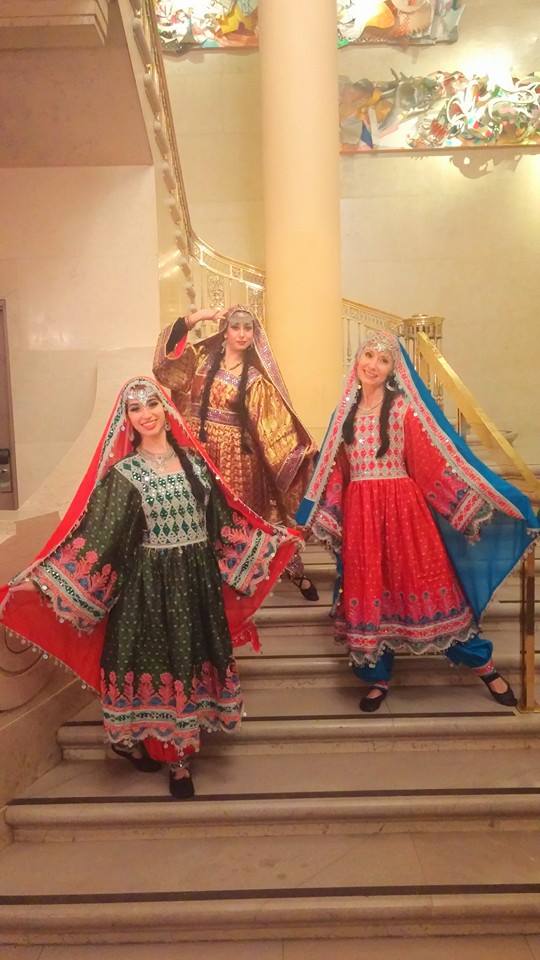
The evening ended with a fashion show, with beautiful traditional costumes and jewellery. I captured this photo of the models in their outfits when they posed in front of the photo wall prior to the fashion show itself.
A wonderful evening of rich colours, music, dance, poetry and food..I truly enjoyed it!